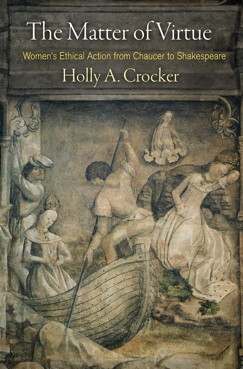
Hoo, it is already February. I am back to teaching one class this term, and despite the reduced number of students, I’m still having to work very hard to remember how to teach, read, and write all at once. So I haven’t been blogging. But I have been writing and reading and teaching all at once, and this post includes new work, and work that will give you a sense of my recent book, The Matter of Virtue: Women’s Ethical Action from Chaucer to Shakespeare(Penn, 2019): https://www.upenn.edu/pennpress/book/16018.html
After my book came out in the fall, the events director at the Athenaeum in Philadelphia wrote me to ask if I’d like to give a talk about my project. “Of course!” I replied, overjoyed that I might get to speak in such a historic, beautiful setting. That’s happening today: https://www.eventbrite.com/e/free-event-virtues-that-matter-with-holly-a-crocker-tickets-85113870879.
In the lead up to that event, yesterday afternoon my friend Emily Steiner and her wonderful students—as well as other delightful medievalist colleagues in Philly—hosted me to talk about my developing work on feminist subjectivity. That talk derived from my recently published ChaucerReviewarticle onThe Knight’s Tale(https://www.jstor.org/stable/pdf/10.5325/chaucerrev.54.3.0352.pdf?seq=1), as well as my forthcoming article on Chaucer’s Melibee, which will appear in A Companion to New Critical Thinking on Chaucer, (ed. by the wonder-team, Lynn Shutters, Matthew Irvin, and Stephanie Batkie, forthcoming on ARC Humanities Press). The Penn group was generous, engaging, and exciting, and I’ll have more to say about how their questions are prompting me to reflect more on my ongoing work on Hoccleve, hopefully soon. For today, I thought I’d just include the text from my Athenaeum talk. Again, it is drawn from my book, which I encourage you to read if you are interested in the full citations (or in some of the images that will appear in the talk). I guess I’ll count this post as one of those, “showing the work” that goes into the long process of bringing an academic book into the world, posts. I’m deeply grateful to have the opportunity to talk about these ideas with a larger audience, and I’m eager to hear any feedback that readers might have to this argument. So please, comment or contact me if you’d like to talk more!!
‘Til soon, h
Holly A. Crocker
University of South Carolina
Hcrocker@mailbox.sc.edu
[Do not cite without permission]
“Virtues that Matter: from Shakespeare’s Hamletto Chaucer’s Legend of Good Women”
When Hamlet advises his mother, “Assume a virtue if you have it not,” he presents virtue as a performance that involves the material body. Yet when he concludes his counsel with the remark, “For use almost can change the stamp of nature” (my emphasis), he suggests Gertrude’s ethical action is limited by the body’s materiality. He does not treat virtue as an embodied capacity, but instead imagines Gertrude’s virtue as a decorative covering, as “a frock or livery / That aptly is put on” (III.iv.151.4-5). Hamlet renders Gertrude’s virtue as superficial, and, by so doing, he forecloses her potential for ethical action. This devaluation of “virtues that matter”—as well as the association of material virtues with women—focuses the argument of my larger project. My current book, The Matter of Virtue: Women’s Ethical Action from Chaucer to Shakespeare,treats medieval and early modern literature, but Hamletprovides the opening case study because Shakespeare’s play dramatizes the vital importance of material virtues while it also reveals the demise of these collective capacities in favor of an ethics that empowers the individual moral agent. Today I’m going to give you a sketch of the larger intellectual argument, a reading of Shakespeare’s Hamletthat highlights its priorities, and a consideration of Chaucer’s Legend of Good Women that suggests why these issues matter.
Like Hamlet, we often think virtue arises from action, but during the late medieval and early modern periods, virtue also derives from material things. In premodern England, virtues are material powers, permeating and connecting physical bodies. This model of ethical excellence relies on a description of virtue familiar from the Nichomachean Ethics: “Moral virtue comes about as a result of habit…we become just by doing just acts, temperate by doing temperate acts, brave by doing brave acts.”[i]Virtues are unthinkable outside embodiment, since, without a body, ethical action is impossible. Premodern English writings evidence a rich, centuries-old tradition of material virtue. This tradition is also Aristotelian, insofar as it appears in The Physics: “the virtues are perfections of nature.”[ii]But these writings do not simply telegraph Aristotle’s notions of material virtue unchanged from ancient iterations. This is no “rebirth” of a classical ideal. Rather, material virtues gained authority from centuries of debate, amendment, adjustment, and review.
Representations of material virtues are rife in late medieval vernacular writing, but this figuration derives from an older Latin tradition. The “tree of virtues” is part of a larger mnemonic structure that system-building philosophers used to communicate the complexity of medieval virtue ethics. We often think of medieval virtues as elaborately hierarchized, and it is true that some medieval thinkers used the tree of virtues to differentiate moral properties root and branch. Nevertheless, such depictions also unify virtue as a flourishing and dynamic system of connected excellences. In a 13thc. copy of the Speculum Virginum, the interconnection of virtues—in accordance with a principle elaborated again from Aristotle’s Nichomachean Ethics—visually insists that moral goods are generative, material, and living. And just incidentally, here is an English version of the same image: this is from Additonal MS 37049, a fifteenth-century Carthusian miscellany described as a “spiritual encyclopedia”—this derives from a poem called, “The Desert of Religion”—shows the longevity and flexibility of this motif]. Hildegard of Bingen’s 12thc. Ordo Virtutum, which features sixteen feminized virtues singing to a humanized Anima, imagines the virtues as the boughs of a tree rooted by the Patriarchs and Prophets (“Nos sumus radices et vos rami, / fructus viventis oculi”; 6-7). Hildegard uses gender allegory to connect female worthies in a moral ecology of excellence, but the naturalism of this motif suggests more than a symbolic association.
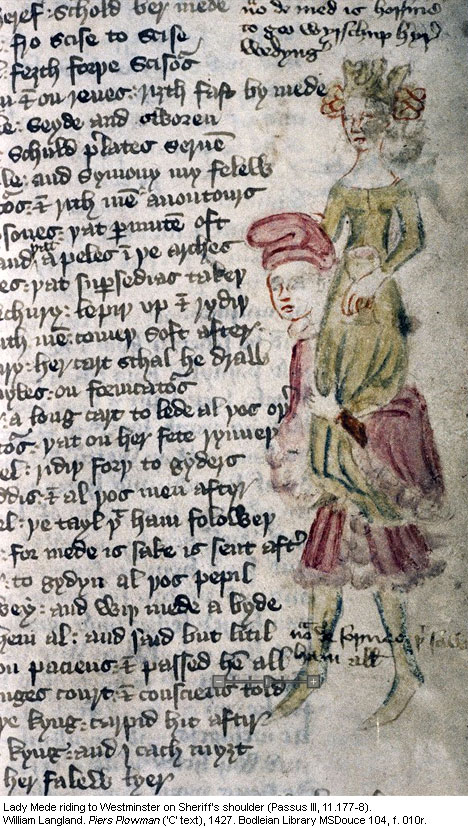
Poetic organicism also allows vernacular writers to investigate the material conditions of shared community. Near the end of William Langland’s fourteenth-century masterpiece, Piers Plowman, the cardinal virtues are represented as grains that Grace sows in the soul of mankind. These traditional excellences—justice, temperance, fortitude, and prudence—are figured as crucial to a thriving polity across their long philosophical and representational history. Accordingly, the corruption Langland imagines in the poem’s grim post-apocalyptic conclusion is social. Pride preys on the “Cristen peple,” but in casting doubt on virtue’s veracity, “With swiche colours and queyntise cometh Pride y-armed” (XIX.355), Langland’s poem levies a broader critique against degraded cultural practices. The erosion of virtue arises from social habits that make moral excellence less substantial. Through abuse, virtue becomes flimsy, fragile, superficial. Ideally, though, Langland suggests virtue has a palpable impact on the world. As Will’s search for Dowel affirms, virtues are not intangible, ethereal principles, but lived practices that rely on material embodiment.
The invocation of virtue’s embodiment in an everyday devotional context was not unique to Langland, either. As medievalists are keenly aware, 1215 saw the greatest pedagogical program ever instituted with the Church’s Fourth Lateran Council. Lateran IV’s canon Omnis utriusque sexus, which required yearly confession for all Christians, meant that a basic set of spiritual information had to be taught. Answering this need, in 1281 Pecham’s syllabus mandated certain rudiments of religious literacy, including instruction in the virtues, for every layperson. Men as well as women were taught the virtues as part of a quotidian system of ethical information. Literatures on the vices and virtues seek to make these qualities more present and memorable for their audiences. As a consequence, late medieval pastoral literatures often use organic figures of spiritual cultivation to guide general audiences. The Book of Vices and Virtues,a fourteenth-century translation of the popular Somme le Roi, returns man and woman to a pre-lapsarian garden of spiritual growth where God grafts virtues into the individual soul. The virtues that God-as-gardener fosters, importantly, are imagined as making a substantial difference in the shared lives of fellow Christians.
Similarly, TheDigby Mary Magdalene, a 15thc. saints’ drama, cannily renders virtues as organic properties, which grow from the seeds Christ implants in the human soul. Mary is embarrassed when she realizes her error, “I wentt ye had byn Symov[n]d þe gardener,” but Christ reassures her:
So I am, forsothe, Mary!
Mannys hartt is my gardyn here.
þerin I sow sedys of vertu all þe 3ere.
þe fowle wedys and wycys I reynd vp be þe rote!
Whan þat gardyn is watteryd wyth terys clere,
Than spryng vertuus, and smelle full sote.
Though we have a hard time talking about them otherwise, renderings of material virtues are not just metaphorical in late medieval vernacular writings. They represent the intersection of matter and discourse, since they were supposed to reflect the direct power that the divine exercises over human excellence.
This is because material virtues were not just religious, nor were they simply literary, or even figurative. I have described a tradition of material virtue as it derives from textual sources. A Latin topos gives rise to a vernacular representation, which takes on its own life across all kinds of visual and poetic representations in later centuries. Good literary critical stuff. But it is more likely that these motifs were recognizable because they were familiar from common suppositions about the natural world. Plants as well as rocks, body parts and corporeal systems: they all had “vertues.” In premodern English, “vertu” was not an abstract, ethereal principle. What Jeffrey Jerome Cohen theorizes as, “life force: reproduction and vitality, affect and intellect and health, that which moves the flesh” (Cohen 2011: 292), the Middle English Dictionarydefines as “An inherent quality of a substance which gives it power.”[iii]The Peterborough Lapidarycharacterizes vertu as follows: “…no man schall be in / dowte Þat god haþe set & put gret vertu in worde, stone, and erbe, by the wyche…many [wonder]full mervailes my3t be wrow3t þorow her vertues” (Evans and Serjeantson 1933: 64).
As Mary Carruthers explains, “vertu” was a “principle of biological energy.” Elsewhere, she notes, vertusignified “that innate ‘power,’ ‘energy,’ or ‘desire’ of the soul animating the body, which (as with babies, puppies and plants) requires channeling, habituation, and training” (86-7). Whether human or nonhuman, insentient or lively, all bodies have virtues. To say that virtues come from sources outside the self, then, does not vitiate the idea that every body is naturally endowed with animating powers. As the 14th c. Dives and Pauperputs it, “God 3af gres, trees and herbis diuerse vertuys.” We might call each of these virtues an affordance, or the ability to flourish in a particular environment. Knowledge of such powers was central to many practices that relied on the explicit interaction of substance and utterance. Premodern medicine relied on the knowledge of material virtues, for, as John Trevisa’s English translation of Bartholomaeus Anglicus’s de proprietatibus rerum explains, “A good physicien…nedip to knowe complexions, vertues, and worchings of medicynable pingis.” A command of material virtue requires intimate local knowledge, including the season for the optimal cultivation of healing plants: “Pese herbys…mustyn be gaderyd abowtyn mydsomer, for panne pei ben of moste vertu.” Chaucer’s famous opening to the General Prologue, then, draws on the substantive, vibrant, connective power of material virtues: “Whan that Aprill, with his shoures soote, / The droghte of March hath perced to the roote, / And bathed every veyne in swich licóur / Of which vertú engendred is the flour”.
This sense of virtue’s material vitality did not disappear in the early modern period. Herbals as well as medicinal tracts attend to the “vertues” of different plants and potions. The brief broadsheet, The admirable vertue, property and operation of the quintessence of rosemary flowersand the meanes to vse it for the sickesses and diseases herein mentioned(1615), equates “vertue” with a potency that is physical: “Moreover, the force and vertue thereof extendeth it selfe euen to the sinewes shrunke and weakned.” (n.p.) In the more comprehensive A boke of the propreties of herbes called an herball (1552), the “vertues” of different plants are associated with distillation, which means that this type of power is thought of as the defining essence of each example included therein. Similarly, A right profitable booke for all diseases. Called The path-way to healthdescribes its contents by referencing virtue as type of potency, “Wherein are to be found most excellent and approoued medicines, of great vertue.” The oft-printed An hospitall for the diseased,by Thomas Cartwright, also proclaims the powers of its practical wisdom by advertising the “most excellent approoued medicines, as well emplaisters of speciall vertue…for the restitution and preseruation of bodily health.” Thinking of vertue as potency is central to medicine’s public standing, or so the English translation of the Latin Prepositasclaims: “when men or women shall, having read this booke, see and understand how that there are in hearbes, plants, gummes &c. such severall vertues…they will be the better perswaded to like and esteeme of phisicke then heretofore they have done” (A1v).
Treating virtue as an embodied capacity was not confined to a specialized vocabulary of science and medicine. To return to Hamlet,when Laertes observes Ophelia’s madness, he curses his eye’s natural powers, “Tears seven times salt / Burn out the sense and virtue of mine eye!” (4.5.154). Later, when Laertes conspires to poison Hamlet he tells Claudius the potion is beyond the powers of any medicine:
And for that purpose I’ll anoint my sword.
I bought an unction of a mountebank
So mortal that, but dip a knife in it,
Where it draws blood no cataplasm so rare,
Collected from all simples that have virtue
Under the moon, can save the thing from death
That is but scratched withal. (4.7.112-118)
As the herbals’ and medicinals’ practical appeals to readers indicate, thinking of virtue as the vital force of a material body was commonplace in early modern England. Moreover, writings from the sixteenth and early seventeenth century also render virtue using vibrant, organic topoi. John Larke’s extended title, The flower of vertue following the authority of auncient doctoures and philosophers deuyding and speaking of vices and vertue, is in keeping with the treatise’s treatment of virtues as “flowers” or “fruits” of prudence. Similarly, Two guides to a good life uses the tree of virtue to distinguish different qualities and to show their relation to one another. The arbor of virtue, like the vineyard of virtue, conceptualizes virtues as both natural and intertwined.
As these examples are meant to show, what I’m calling “material virtues” arise from embodiment, and they allow their practitioners to maintain dignity even in circumstances that are beyond their control. When these virtues arise as a consequence of harms, they are not simply an expression of mourning or lamentation. Rather, material virtues also entail a critique of the conditions that produce them.As I maintain, material virtues body forth the prevailing modes of governance in a way that exposes them to critique. Their persistent vitality is a disruptive counter to the forms of public action approved by dominant social powers. Nowhere is the unsettling vibrancy of material virtue more evident than in Shakespeare’s Hamlet. Across the play, material virtues become visible as the rationalist and theatrical model of virtue recommended to Gertrude disintegrates.
This is due in part to Hamlet’s performance of madness; when he kills Polonius, Hamlet’s claim to cloak calculated action under the cover of madness breaks down. Hamlet still purports to maintain his wits. Yet Hamlet’s continued disrespect for Polonius drives Laertes into a moral cycle of vengeance that is not too far removed from that of the play’s titular protagonist. More disturbing, however, is Ophelia’s reaction to Hamlet’s murder and mistreatment of her father. Ophelia is moved to madness by her former suitor’s violence and disregard. But her break with reason, critics have observed, is not without rhyme.
Ophelia’s songs are popular street ballads. Putting such songs in the mouth of a madwoman, Mary Ellen Lamb points out, means that Shakespeare has erected a binary of elite/popular, male/female to establish theatre’s cultural superiority. The content of the ballads Ophelia performs, however, gives her grief a kind of virtue. A betrayed lover’s song, a dirge for a dead beloved, and a ballad of a maiden’s downfall: through these songs, Ophelia delineates a visceral awareness of the harms she has suffered, so that her performance gives her dignity even as she becomes a spectacle of tragedy. Caralyn Bialo observes that Ophelia’s songs allow her to inhabit female subject positions usually placed off limits for elite women, such as herself. Ophelia bodies forth the voices of sexually aware, socially expendable women. Ophelia does not go quietly. Rather, her shocking vitality condemns the conditions that have led to her madness. Hamlet’s vengeance, though he might choreograph it to catch the conscience of Claudius, also entails Ophelia’s reckless and heedless destruction.
Hamlet treats virtue as a superficial guise that might be donned, but Ophelia’s demise once again attests to the complex intersection of matter and discourse in the making of premodern virtue. With his observation, “This nothing’s more than matter,” Laertes acknowledges that Ophelia achieves more than madness with her carefully gathered nonsense. Besides the songs she sings, Ophelia presents a catalogue of plants that give material substance to her virtue. These plants, scholars have noted, provide a rich commentary on her suffering:
There’s rosemary, that’s for remembrance. Pray, love, remember. And there is pansies; that’s for thoughts…There’s fennel for you, and columbines. There’s rue for you, and here’s some for me. We may call it herb-grace o’ Sundays. O, you must wear your rue with a difference. There’s a daisy. I would give you some violets, but they withered all when my father died.” (4.5.173-4; 178-81)
Rosemary and pansies focus the mind on remembrance of loss. Fennel and columbines signal flattery and infidelity. Rue symbolizes regret, sometimes repentance. The daisy was long associated with self-sacrifice in love on account of Alcestis; her belief in an unfaithful lover, however, also linked the plant to dissembling. Violets are signs of faithfulness, and their death is a totalizing rebuke to the Danish court and its prince. Taken together, the emblematic resonance of Ophelia’s botanical offerings critiques Hamlet’s betrayal and laments Polonius’s murder. But these plants were also believed to have virtues that were not simply derived from their symbolic associations. Most of Ophelia’s plants are herbs, and all were thought to have medicinal power during the early modern period. The “vertues” of each, as my earlier examples attest, exerted physical power over material bodies.
Rosemary was widely used to promote a clear head, and to ward off plague.Pansies were described as an anti-inflammatory, and were credited with curing the falling sickness as well as convulsions. Fennel and columbines were both healing and poisonous. Like many of Ophelia’s herbs, rue is connected to sexuality and reproduction: according to John Gerard’s Herball, it not only “expels the dead child and after|birth,” it also “opens the matrix, and brings it into the right place.” And too, it serves as a “re|medie against the inflammation and swelling of the stones, proceeding of long abstinence from ve|nerie.” Its capacity to protect and renew bodies is more extensive, however, since rue was believed to be a powerful antidote against a variety of poisons: “[Rue] is a counterpoyson a|gainst deadly medicines or the poyson of Wolfs-bane, Ixia,Mushroms, or Tode-stooles, the biting of Serpents, stinging of Scorpions, spiders, bees, hornets, and wasps.”When she at last points to the daisy, Ophelia rounds out a bouquet with the power to harm as well as heal, protect as well as poison.
As Rebecca Laroche notes, the critical history of Hamlet has foreclosed the idea that Ophelia distributes actual plants during this distressing scene. Doing so, I suggest, sidelines the material virtue that Ophelia enacts. If Ophelia shares these plants with Gertrude, Claudius, and Laertes, as Laroche argues, it is neither a neutral nor a symbolic act. Laroche details the ways in which gentlewomen used a detailed knowledge of plants to gain autonomy and authority over household relations. I suggest it is a material ethics, which, for Stacy Alaimo and Susan Hekman:
entails…that we can compare the very real material consequences of ethical positions and draw conclusions from those comparisons. We can, for example, argue that the material consequences of one ethics is more conducive to human and nonhuman flourishing than that of another.[iv]
This form of material virtue, furthermore, enables Ophelia to warn those who have perpetrated the injuries she endures. In other words, the medicinal plants she offers provide a last chance for a reparative reconfiguration of the Danish court. Without change, the poison of so many unremedied wrongs will fester and spread. By noting the absence of violets in her gathering of plants, “I would give you some violets, but they withered all when my father died,” Ophelia denounces the loss of faithfulness that Polonius represented. She also affirms the difficulty of moral change, given that the beauty of violets were meant to instill ethical virtues in their beholders. As Gerard’s Herballexplains:
and the re|creation of the minde which is taken hereby, cannot be but very good and honest: for they admo|nish and stir vp a man to that which is comely and honest; for floures through their beautie, variety of colour, and exquisite forme, do bring to a liberall and gentle manly minde, the remembrance of honestie, comelinesse, and all kindes of vertues.
Though beauty might exert as much force over bodies as violence, classifying Ophelia’s performance as “a document in madness”—a scripted, disembodied record of her individual suffering—prevents her virtues from reaching those who witness her enacted woe.
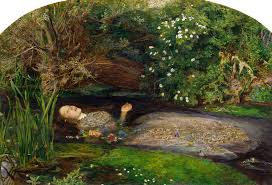
Ophelia’s death confirms what Polonius’s murder previously suggested: certain bodies are socially and ethically dispensable. Laertes then Hamlet may jump into Ophelia’s grave, but their theatrical mourning is simply part of the public masculine contest they wage against one another. When Ophelia makes herself visible—as broken, disheveled, and discarded—she uncovers a material virtue that stands in direct opposition to the public posturing of Hamlet then Laertes. Unlike Hamlet’s madness, which is donned for social advantage, Ophelia’s madness is a scandal that subjects the court’s values to critical scrutiny. When Gertrude reports Ophelia’s death, she paints a picture of a faithful maiden whose drowning was precipitated by her lover’s desertion: while attempting to hang garlands of flowers on a willow, as abandoned lovers were proverbially said to do during this period, a branch breaks and Ophelia is drowned in the tangled weight of her garments. If her madness prevents her from preserving herself, her death also indicts Hamlet’s use of Ophelia as an expendable prop in the revenge tragedy he plots against Claudius.
Some might object that material virtue is unsurvivable, that Ophelia’s excellence is predicated on her endurance of harm. In fact, because it arises from the materiality of the body, her virtue is in keeping with what political theorist Bonnie Honig has recently termed “mortalist humanism,” a species of posthumanism that derives ethics from vulnerability, not rationality. Honig does not identify this trend to complement it; indeed, for her, it is a departure from politics that she sees as problematic. Yet Honig’s critique, as well as the objection that material virtue is predicated, like so many stories of old, on the suffering of an abandoned woman, is directed at the wrong type of virtue. Ophelia is not dragged under by virtues that matter, those embodied, immediate excellences which allow Ophelia to mine a discourse of femininity that includes experiences of the physical body–a tradition, which, Pamela Allen Brown and Rebecca Laroche convincingly argue, allows women to find solidarity through the language of ballads and a knowledge of plants . Rather, the model of virtue that Hamlet extols, which he recommends to his mother when he advises her not to sleep with Claudius, is the prescriptive, theatrical, and superficial form of virtue that causes Ophelia’s destruction.
This play’s relentless focus on the individual prison of harms—the mental isolation that comes from suffering wrongs–means that Ophelia’s virtues cannot circulate. She is cut off, stranded in a domain where virtue is viewed as a theatrical display of the discrete subject. To confine virtue within the definite bounds of the individual self makes that isolated subject the only outlet for ethical action, the play affirms. And, as Ophelia (then Hamlet) demonstrates, cabining virtue in this fashion is (self)destructive. To think about why, this talk ends where it might have begun, with a consideration of Chaucer’s Legend of Good Women. In his final dream vision Chaucer struggles to write within the limited discursive space allowed by an empowered masculinity: to do so, he represents good women according to traditional criteria for feminine virtue—principally fidelity, suffering, and self-sacrifice. Feminist critics have rightly identified the problematic gender politics of The Seintes Legende of Cupide; yet I suggest the problem they pinpoint has more far-reaching consequences for reappraising the human subjectivity that comes to such cultural prominence in Hamlet.[v]It is not just gender trouble, but virtue trouble, that is at issue from Chaucer’s Legend to Shakespeare’s Hamlet. Indeed, as the Legendaffirms, there is an ethical problem at the heart of our conceptions of what constitutes a viable, modern selfhood.
That’s because Chaucer’s Legend of Good Womenraises the important question: why do material virtues fail to invest good women with cultural power, especially when men’s predatory abuses of their cultural privilege are simultaneously laid bare?[vi]Chaucer initially confronts this question by showing how a model of ethics derived from and based upon elite masculine excellence—on virtus—diminishes women, along with most men. By representing Chaucer’s own precarity under the God of Love’s gaze—“For sternely on me he gan byholde” (F.239)—the Legend of Good Womenchallenges the artistic tradition that makes women’s ethical action a support for men’s cultural authority. It does so by demonstrating the need for material virtue as a counter-tradition of ethics that can be inhabited by the dispossessed—canonically women, but just as often men. Chaucer puts himself in the place of a vulnerable woman under a domineering masculine gaze as a way to acknowledge the restricted cultural frame within which the goodness of his abandoned heroines might be perceived.[vii]As the tales in this collection go on to show, the virtues of vulnerable women open a different vista on the ethical lives we share with others. They show that moral good does not simply amount to cultural power. By investing his heroines with bodily resources of excellence—endurance, fidelity, and pity, for example—Chaucer imagines the ways that vulnerability might recalibrate what qualifies as a virtuous response to unjust treatment.[viii]
The Legend of Lucrecechallenges the idea that rape is a political weapon, or that rape is somehow generative for and even foundational to great western cultures.[ix]Unlike other versions of the story, Chaucer uncovers the social utility of women’s violation in patriarchal culture.[x]Chaucer initially distances his rendering from this story’s traditional function as a Republican fable, in which the “kynges of Rome”—the Tarquini—are overthrown for their tyranny. Instead, the narrator claims, “[F]or that cause tell I nat this storye, / But for to preyse and drawe to memorye / The verray wif, the verray trewe Lucresse” (F.1684-86). To celebrate Lucrece’s “wifhod and hire steadfastness” (F.1687), however, is to recount a masculine contest that establishes the worth of husbands based on the quality of wives. Nevertheless, Lucrece’s virtue also critiques the ethical system that establishes masculine dominance: the rape that prompts her self-destruction is explicitly linked to Tarquin’s presumption of cultural privilege.[xi]In describing him as “a wolf that fynt a lomb alone” (F.1798), Chaucer confronts the violence entailed by a virtusbased on the exercise of agency over subordinates. Lucrece’s care for her own name, which provoked dismissive disdain from Augustine, despite the Legend’s insistence that “The grete Austyn hath gret compassioun” (F.1690), achieves a dignity that equally extends to her body.[xii]Her performance of modesty, more than rote adherence to an externally imposed code of conduct, affirms Lucrece’s active investment in her own embodied excellence.[xiii]
To view this story as silly, or to regard heroines including Cleopatra or Thisbe as beset by “sheer stupidity and blindness,” in Elaine Tuttle Hansen’s words, is to express a wish that the virtue of these women could be accommodated by the tradition of virtusthat defines heroism according to exercises of individual agency and personal control.[xiv]Hansen is correct to observe the critical treatment of classical heroes in Chaucer’s Legend, but her indictment of “the pervasive and sometimes comic passivity, irrationality, and stupidity of the composite good woman depicted in the Legends [, which] tempts the reader to agree with the critic who thinks that these ladies only get what they ask for…” is sustainable if we believe that only one model of virtue is conceivable, so that women’s equality results from their inclusion within an ethical and social system that has traditionally depended upon their exploitation and degradation for its very ability to function.[xv]Chaucer shows the impossibility, as well as the undesirability, of this egalitarian fantasy. Chaucer is not interested in valorizing a classical model of virtue, but shows, rather, that this traditional model of ethics produces bad men, who in turn organize social structures in way that are harmful to nearly everyone.
In their dynasty-making sojourns, heroes including Jason, Theseus, and Demophon reveal that men’s world-making power is staked on exploiting the bodies, brains, and virtues of those (women) who are more vulnerable than they are. Chaucer does not just respond to misogyny in an effort to gain women greater recognition as ethical subjects; instead, he challenges the ethical organization of his culture, placing women at the center of human experience in an effort to rethink the ethical criteria of the human itself. By so doing, he suggests women and men should be governed by a morality that includes pity for others. That women already evince this characteristic provides incontrovertible evidence that something is amiss in the value structure that awards men—especially predatory men—cultural dominance in premodern England. An important reason to end this talk with a consideration of Chaucer’sLegend, then, is because it lays bare the logic of gender that traditional virtue ethics supports: men are predatory, but they suffer no consequences for their exploitation of the vulnerable; women are virtuous, but they gain no social power from their embodied excellence.
Chaucer’s Legend of Good Womenasks what happens if virtue is recognized only in those with cultural power. His heroines bear up against oppression; they uncover the circuits of bodily desire, affect, and emotion that predicate effective action against tyrannical cultural powers. Yet, women such as Philomela and Medea, unlike their classical namesakes, are afforded no powers of vengeance in Chaucer’s collection. By suggesting that the narrator might be in the same position as his vulnerable heroines, I propose that Chaucer rejects a model of virtue that ensconces elite individualist power. The narrator emphasizes Philomela’s innocence, “For this is al and som: thus was she served, / That nevere harm agilte ne deserved / Unto this crewel man, that she of wiste” (F. 2384-86). Similarly, Medea’s story ends with a lament wherein she questions her prior judgments:
Whi lykede me thy yelwe her to se
More than the boundes of myn honeste?
Why lykede me thy youthe and thy fayrnesse,
And of thy tonge, the infynyt graciousnesse? (F.1672-75)
Medea’s self-awareness does not lead to a frenzy of violence, but, rather, substantiates the tale’s denunciation of Jason’s faithless exploitation. When she wishes him dead, “O, haddest thow in they conquest ded ybe, / Ful mikel untroughte hadde ther deyd with the!” (F.1676-77), Medea preserves her dignity in the face of Jason’s mistreatment. And, while these women show the potential of material virtue—a model of ethics that connects bodies in nourishing alliance—their stories uncase the masculinist model of power that destroys such reparative vertues. In sum, as the Legends indicate, material virtue cannot be treated as an additive element, or a feminine complement, to a classical model of virtus.
Rather, and as my book argues, poets from Chaucer to Shakespeare construct an alternative foundation for ethics based on vulnerability. This occurs largely for formal reasons: as different poets represent characters whose actions reflect upon an ideal of human goodness, a practical ethics based on embodied vulnerability emerges. Indeed, a different ethical world appears when the fact of our common vulnerability grounds understanding of the human and its excellences. Shifting the grounds of the human upends gender difference, and suggests we need new modes of social organization. Through their female characters, poets from Chaucer to Shakespeare imagine new modes of ethical action based on intimacy and protection, not domination and governance. In arguing for The Matter of Virtue, then, I suggest that imagining women’s ethical excellences as embodied, living, and connective remains a world-remaking project.
[i]Aristotle, Nichomachean Ethics, trans. H. Rackham, Loeb Classical Library (Cambridge, MA: Harvard University Press, 1926).
[ii]Aristotle, Physics, Books 5-8, trans. P.H. Wicksteed and F.M. Cornford, Loeb Classical Library, 255 (Cambridge, MA: Harvard University Press, 1934), VII.iii (247a).
[iii]Middle English Dictionary, s.v. “vertu” (8a).
[iv]Stacy Alaimo and Susan Hekman, “Introduction: Emerging Models of Materiality in Feminist Theory,” Material Feminisms, ed. Stacy Alaimo and Susan Hekman (Bloomington: Indiana University Press, 2008), 7.
[v]Key treatments include, Delany; Carolyn Dinshaw, Chaucer’s Sexual Poetics(Madison, WI: University of Wisconsin Press, 1989), 65-87; Elaine Tuttle Hansen, “Irony and the Antifeminist Narrator in Chaucer’s Legend of Good Women,” JEGP82 (1983): 11-31; Jill Mann, Geoffrey Chaucer(London: Harvester Wheatsheaf, 1991), 26-38; Priscilla Martin, Chaucer’s Women: Nuns, Wives, and Amazons(London: Macmillan, 1990), 196-210; recently, the special issue of The Chaucer Review, 52.1 (2017), ed. Betsy McCormick, Leah Schwebel, and Lynn Shutters, has returned critical attention to the Legend of Good Women. While this book was drafted before this issue appeared, I have sought to acknowledge the brilliant interventions of this collection and its contributors.
[vi]Lynn Shutters, “The Thought and Feel of Virtuous Wifehood, 85-105, and Irina Dumitrescu, “Beautiful Suffering and the Culpable Narrator in Chaucer’s Legend of Good Women,” 106-23, suggest that this poem is part of a tradition that idealizes the suffering of women. I depart from these readings because I see the narrator as vulnerable in the same fashion as the heroines featured in Chaucer’s collection.
[vii]As John Ganim, “Chaucerian Ritual and Patriarchal Romance” Chaucer Yearbook1 (1992): 65-86, remarks, “the poet [is] in the position of the good women themselves, bereft of any choice but one so severely limited as to verge on self-destruction” (81).
[viii]Steele Nowlin, “The Legend of Good Womenand the Affect of Invention,” Exemplaria25 (2013): 16-35, argues that the poem represents invention as an affective force, one that is linked in his analysis to the heroines’ intensities of feeling.
[ix]Unlike Ovid’s Metamorphoses, the complaints of abandoned women featured in Chaucer’s sources, principally the Heroides, at least recognize another perspective on the sexual predations of powerful men. As Marilynn R. Desmond suggests, “The Translatioof Memory and Desire in The Legend of Good Women: Chaucer and the Vernacular Heroides,”Studies in the Age of Chaucer35 (2013): 179-207, Chaucer’s poem “records Chaucer’s recognition of the auctoritasof the Heroides” (186). Suzanne Hagedorn, Abandoned Women: Rewriting the Classics in Dante, Boccaccio, and Chaucer (Ann Arbor, 2004), 21–46, provides a helpful survey of medieval receptions of the Heroides.
[x]See Corinne Saunders, Rape and Ravishment in the Literature of Medieval England (Cambridge: D.S. Brewer, 2001), 265-74; and Andrew Galloway, “Chaucer’s Legend of Lucreceand the Critique of Ideology in Fourteenth-Century England,” ELH 60 (1993): 813-32.
[xi]See Leah Schwebel, “Livy and Augustine as Negative Models in the Legend of Lucrece,” 29-45, which helpfully shows how Chaucer rejects earlier renderings of Lucrece.
[xii]See Augustine, The City of God, trans. Marcus Dods (New York: Random House, 1950), 1.18-19, claims that Lucrece committed a crime with her self-slaughter (and speculates she might have done so because she felt guilt—guilt induced by pleasure at her own sexual violation). See Delany, 203-206, who gives the full passage from Augustine, and discusses its problematic implications in the context of Chaucer’s poem.
[xiii]Julia Annas, Intelligent Virtue(Oxford: Oxford University Press, 2011), insists that Aristotelian virtue ethics is not about the rote repetition of externally imposed moral norms. McCormick, 128-29, argues that the uncertainty of the poem, and The Legend of Lucrece, in particular, asks readers to decide upon the grounds of the ethical itself. My thinking about ethical and erotic normativity across this book—particularly in Chaucer—is indebted to Mark Miller, Philosophical Chaucer(Cambridge: Cambridge University Press, 2004).
[xiv]Elaine Tuttle Hansen, “Irony and the Antifeminist Narrator in Chaucer’s Legend of Good Women,” JEGP82 (1983): 11-31 [24].
[xv]Ibid., 25. Hansen, “The Feminization of Men in Chaucer’s Legend of Good Women,”Seeking the Woman in Late Medieval and Renaissance Writings: Essays in Feminist Contextual Criticism, ed. Sheila Fisher and Janet E. Halley (Knoxville, TN: University of Tennessee Press, 1989), 51-70, takes up the poem’s critical treatment of men.









 Holly A. Crocker